

Balancing Cost, Speed & Reliability: How Businesses Are Optimizing Air and Ocean Freight Strategies
Logistics costs account for 10 to 15% of total product costs for most businesses worldwide, and that figure rises when freight decisions are made reactively rather than strategically. In recent years, that reactive approach has become increasingly costly. Port congestion, geopolitical tensions affecting trade corridors, and unpredictable demand cycles have forced businesses to rethink how they move goods across borders.
The old way of selecting freight based on cost alone, or defaulting to air simply because a deadline is tight, no longer holds up under the complexity of modern trade. What businesses actually need is a freight strategy that is deliberately built, one where logistics planning drives mode selection, not the other way around. And that requires a much clearer understanding of what air and ocean freight each genuinely offer within a wider logistics and supply chain management framework.
Why Freight Mode Selection Has Become More
Complex
Ten years ago, the freight decision for most businesses was relatively simple. Large volumes going long distances went by sea. Urgent or high-value cargo went by air, and everything else was figured out case by case. That approach does not work particularly well anymore.
- Customer expectations have shifted, and delivery windows that were once acceptable are now considered slow.
- Demand patterns have become harder to read, which makes inventory planning more difficult. Businesses are also under pressure to reduce working capital tied up in stock, which means they cannot afford long transit times without strong forecasting to compensate.
- What this has produced is a more complicated set of freight decisions. Choosing a mode now involves weighing transit time against reliability, inventory implications against transportation cost, and risk exposure against service continuity.
- Freight forwarding is no longer a transaction; it is a function that comes at the center of logistics and supply chain management strategy.
Understanding the Strengths of Air Freight
Air freight services are expensive, and businesses that use them well are usually very clear about when that expense is justified.
- Time-sensitive shipments, high-value goods, critical spare parts, seasonal inventory that has a narrow window of relevance, and urgent replenishment when supply gaps open up are the situations where air cargo solutions earn their value.
- There is also an inventory angle that often goes underappreciated. When goods arrive faster, businesses do not need to hold as much buffer stock.
- For categories where storage costs are high or product lifecycles are short, reducing inventory through faster transit can offset a meaningful portion of the freight premium.
- Air freight also provides a continuity option when other supply chain links become unreliable.
Where Ocean Freight Remains Essential
No other mode comes close to ocean freight when it comes to cost efficiency at scale.
- For large-volume, planned inventory movement across long distances, ocean cargo Management is not just the most affordable option; it is often the only practical one. The economics of moving bulk cargo by sea are simply not replicated elsewhere.
- The requirement, though, is planning discipline. Ocean freight rewards businesses that can forecast accurately and build appropriate lead time into their supply cycles. When that foundation is in place, the savings are significant, and the model is highly scalable for international trade operations.
- What makes it work operationally is visibility, knowing where a shipment is at any point in its journey, when it will arrive, and having enough advance notice to manage exceptions.
- Freight forwarding partners who provide genuine, real-time ocean cargo management visibility are what separate a smooth ocean freight operation from one that consistently creates downstream inventory problems.
How Businesses Are Combining Air and Ocean Freight for Better Outcomes
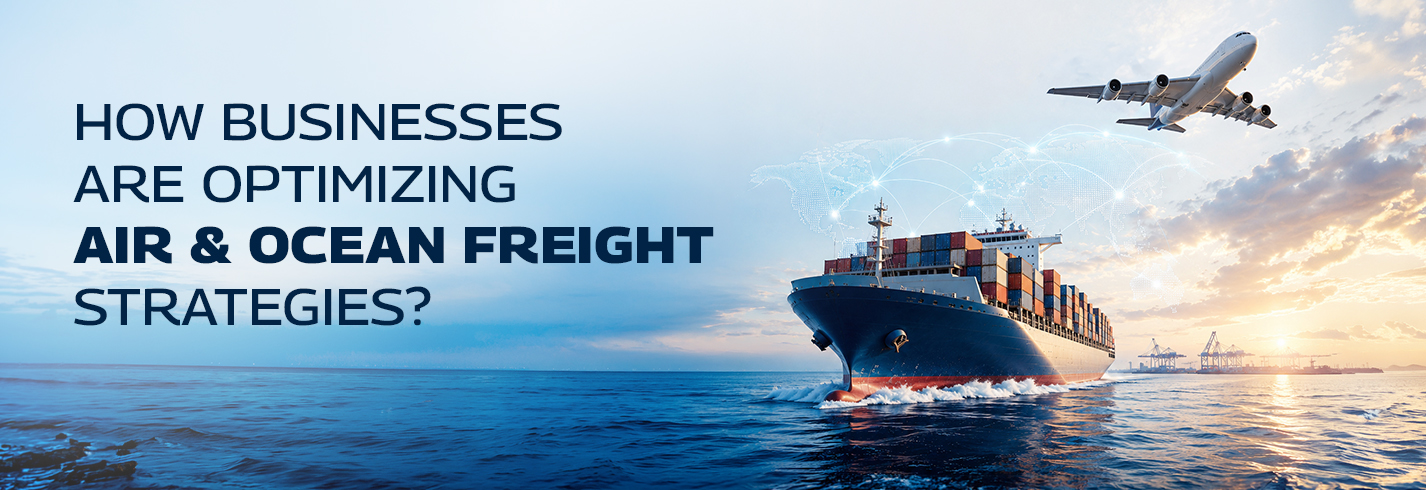
Businesses running purely on one mode are missing out on efficiency. The most practical freight strategies today use both air and ocean deliberately, allocating based on urgency, volume, demand patterns, and customer commitments rather than defaulting to habit.
- Fast-moving or time-critical inventory moves by air. Planned, bulk replenishment moves by sea. And when conditions change, demand spikes, a key supplier runs late, a market window opens earlier than expected, the allocation shifts to match the new reality.
- Dynamic freight management requires integrated logistics planning and centralized visibility across the entire network. Technology enables it: real-time tracking, demand forecasting tools, and data-driven mode selection give operations teams what they need to balance cost and service without sacrificing one for the other.
Air cargo solutions and ocean cargo management are no longer separate conversations, They’re part of a unified logistics strategy.
Conclusion
Freight strategy is not a problem that gets solved once. Supply chains evolve, trade conditions shift, and what worked last year may not be the right approach this year. Businesses that build genuine flexibility into their logistics planning, using air and ocean freight in combination, supported by strong visibility and integrated decision-making, are better positioned to manage
cost, maintain reliability, and respond to disruption without losing ground.
To discuss a freight strategy suited to your supply chain, write to us at enquiries@mahindralogistics.com.