

• Track Your Orders
  • Book Alyte Now
Mahindra Logistics
logotype
Mahindra Logistics
  • About Us
    • Our Brand Story
    • Mahindra Rise
    • Seino MLL Logistics Private Limited
    • Sustainability
    • Leadership Team
    • Investor Relations
  • Solutions
    • Contract Logistics
      • Integrated Warehousing & Distribution
      • ProTrucking
      • Transport Desk Management
      • Full Truck Load Transportation
      • Auto Outbound
      • Rail Logistics
      • Fulfilment Centres
      • Sort Centres
      • Distribution Solutions
      • Warehousing Solutions
      • In-Plant Logistics
    • Freight Forwarding
      • Air Freight
      • Ocean Freight
      • Air Charter Solutions
      • Project Cargo (ODC)
      • LCL Solutions
    • B2B Express
      • Air Express
      • Surface Express
      • Regional Distribution
    • Last Mile Delivery
      • Micro Fulfilment Centres
      • Sub Same-Day Delivery
      • Sustainable Last Mile Delivery
    • Mobility Solutions
      • Alyte
      • Alyte for Enterprises
  • Industries
    • Automobile
    • Engineering
    • Consumer
    • Pharmaceutical
    • E-Commerce
    • Telecom
  • Technology & Innovation
    • LOGIONE
    • Catapult
    • Techathon
  • People & Culture
    • Life at MLL
    • Code of Conduct
    • Diversity & Inclusion
    • Learning & Development
    • Work with us
  • Green Logistics
    • Sustainable Warehousing Solutions
    • Green Last Mile Delivery
  • Insights
    • Stories
    • Blogs
    • Newsletter
  • About Us
    • Our Brand Story
    • Mahindra Rise
    • Seino MLL Logistics Private Limited
    • Sustainability
    • Leadership Team
    • Investor Relations
  • Solutions
    • Contract Logistics
      • Integrated Warehousing & Distribution
      • ProTrucking
      • Transport Desk Management
      • Full Truck Load Transportation
      • Auto Outbound
      • Rail Logistics
      • Fulfilment Centres
      • Sort Centres
      • Distribution Solutions
      • Warehousing Solutions
      • In-Plant Logistics
    • Freight Forwarding
      • Air Freight
      • Ocean Freight
      • Air Charter Solutions
      • Project Cargo (ODC)
      • LCL Solutions
    • B2B Express
      • Air Express
      • Surface Express
      • Regional Distribution
    • Last Mile Delivery
      • Micro Fulfilment Centres
      • Sub Same-Day Delivery
      • Sustainable Last Mile Delivery
    • Mobility Solutions
      • Alyte
      • Alyte for Enterprises
  • Industries
    • Automobile
    • Engineering
    • Consumer
    • Pharmaceutical
    • E-Commerce
    • Telecom
  • Technology & Innovation
    • LOGIONE
    • Catapult
    • Techathon
  • People & Culture
    • Life at MLL
    • Code of Conduct
    • Diversity & Inclusion
    • Learning & Development
    • Work with us
  • Green Logistics
    • Sustainable Warehousing Solutions
    • Green Last Mile Delivery
  • Insights
    • Stories
    • Blogs
    • Newsletter
Mahindra Logistics
Mahindra Logistics
  • About Us
    • Our Brand Story
    • Mahindra Rise
    • Seino MLL Logistics Private Limited
    • Sustainability
    • Leadership Team
    • Investor Relations
  • Solutions
    • Contract Logistics
      • Integrated Warehousing & Distribution
      • ProTrucking
      • Transport Desk Management
      • Full Truck Load Transportation
      • Auto Outbound
      • Rail Logistics
      • Fulfilment Centres
      • Sort Centres
      • Distribution Solutions
      • Warehousing Solutions
      • In-Plant Logistics
    • Freight Forwarding
      • Air Freight
      • Ocean Freight
      • Air Charter Solutions
      • Project Cargo (ODC)
      • LCL Solutions
    • B2B Express
      • Air Express
      • Surface Express
      • Regional Distribution
    • Last Mile Delivery
      • Micro Fulfilment Centres
      • Sub Same-Day Delivery
      • Sustainable Last Mile Delivery
    • Mobility Solutions
      • Alyte
      • Alyte for Enterprises
  • Industries
    • Automobile
    • Engineering
    • Consumer
    • Pharmaceutical
    • E-Commerce
    • Telecom
  • Technology & Innovation
    • LOGIONE
    • Catapult
    • Techathon
  • People & Culture
    • Life at MLL
    • Code of Conduct
    • Diversity & Inclusion
    • Learning & Development
    • Work with us
  • Green Logistics
    • Sustainable Warehousing Solutions
    • Green Last Mile Delivery
  • Insights
    • Stories
    • Blogs
    • Newsletter
< Back
Back

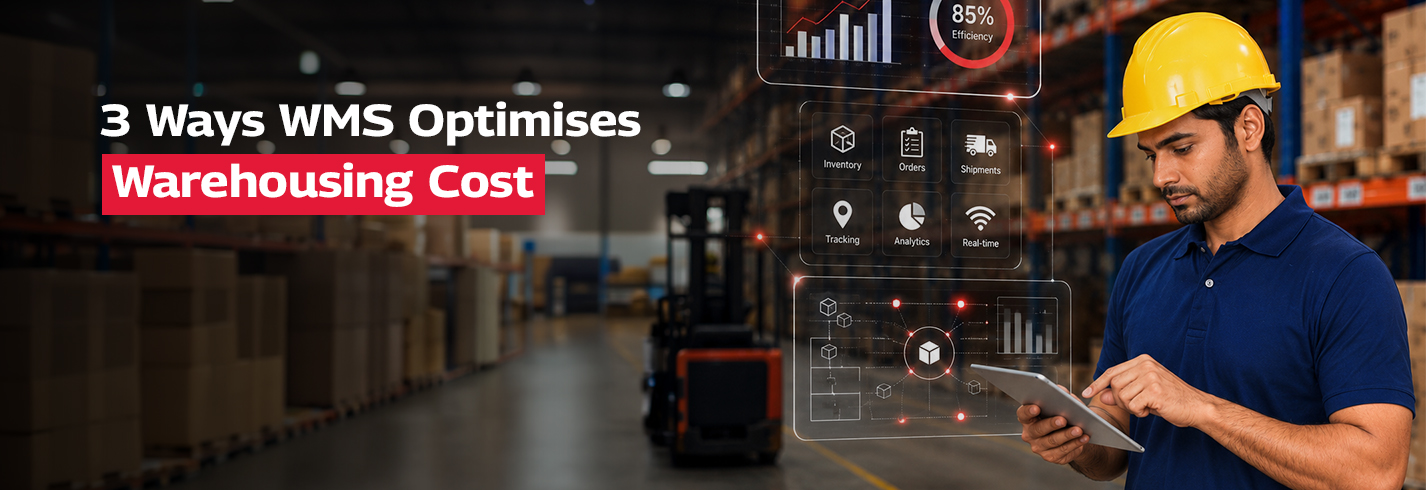
3 Ways WMS Optimises Cost Without Compromising Service Levels

Warehouses in 2026 are under pressure to do two things at the same time: control costs and maintain dependable service. Customers expect faster deliveries, accurate orders, and real-time tracking, while operators are managing manpower shortages, higher rentals, and tighter compliance requirements. The shift is also visible in technology spending, with the global warehouse management system market positioned at USD 4.77 billion in 2026.

At the same time, omni-channel warehousing and distribution have made inventory placement more important than ever, because stock needs to be in the right warehouse before fulfilment starts. In this environment, a WMS is no longer just an IT upgrade. It has become a practical operational and cost-control tool. At Mahindra Logistics, we see this as part of a broader move toward technology-led execution that improves visibility, speed, and accuracy at scale.

Manual vs Automated Warehouse: The Cost & Service Comparison

A manual warehouse typically relies on paper-based processes, physical follow-ups, and repeated supervisor intervention. That often leads to higher error rates, limited visibility, and issue resolution that happens only after service is affected. As a result, service quality can vary across shifts and volumes.

  • An automated or WMS-enabled warehouse works with system-directed workflows, cleaner transaction data, and real-time dashboards.
  • Managers can spot delays earlier, monitor performance more consistently, and act before small problems become service failures.
  • Automation does not reduce service quality. It improves consistency while also cutting waste.

3 Major Cost Drivers in Modern Warehousing

Most warehouse costs do not rise because of one major failure. They rise because small inefficiencies repeat every day. Staff productivity suffers when work is assigned manually.

  • Inventory costs increase when stock records are not accurate. Space becomes expensive when products are placed in the wrong locations and teams spend more time moving them than necessary.
  • Documentation delays also add cost. Manual paperwork slows receiving, dispatch, and compliance checks.
  • Returns handling becomes more expensive when picking or packing errors happen too often. Delivery delays can then create service penalties that affect both cost and customer confidence.

This is also where the discussion around a manual vs automated warehouse becomes important. In manual environments, these issues stay hidden for longer because data is updated late and decisions depend heavily on supervision. That is one reason why leading warehousing services providers are shifting to digital-first operating models.

How Warehouse Management Systems Have Evolved in 2026?

A modern warehouse management system does not just record stock movement. It connects inventory visibility, order flow, and dispatch readiness in one operating system. It also works with ERP and transport platforms. So, warehouse activity supports the wider supply chain instead of working separately.

  • In 2026, businesses expect a WMS to be cloud-based, analytics-ready, and capable of supporting handheld devices, scanning, and automation.
  • It should help managers see what is happening across receiving, put-away, picking, packing, and outbound processing in real time. That is where many long-term warehouse management system benefits begin, because better control at each step
    reduces avoidable cost across the whole operation.

3 Ways WMS Cuts Cost While Improving Service Levels

A WMS improves fulfilment by organising picking, packing, and dispatch more effectively. Orders move faster because the process is structured.

  • Streamline routine tasks: A WMS replaces repetitive manual work with digital pick lists, barcode scanning, and automated task allocation. This reduces paperwork, lowers the risk of human error, and speeds up fulfilment. As workflows become more consistent, teams process more orders with less wasted time and fewer costly mistakes. This becomes even more important for businesses that work with pan-India warehousing and distribution networks. These businesses work with multiple warehouse companies or operate across larger networks.
  • Support a better workforce experience: Today’s employees learn faster on systems that feel clear and intuitive. An easy-to-use WMS shortens onboarding, improves daily productivity, and helps workers complete tasks accurately with less frustration. Better usability can also strengthen morale and retention, which protects service levels during busy periods.
  • Gain tighter inventory visibility: With real-time stock data, cycle counting, and smarter replenishment planning, businesses can avoid overstocking and react faster to demand changes. That means lower carrying costs, fewer stockouts, and stronger order reliability. Better control also helps reduce losses from misplaced goods, shrinkage, or inaccurate counts.

At one beauty and personal care warehouse, Mahindra Logistics built a high-precision operating model around LOGIPICK WMS, with batch, manufacturing date, expiry, and piece-level tracking built into daily execution. Real-time HHT updates, barcode-based data capture, shelf-life controls, and SAP integration improved traceability across inbound, outbound, packing, and labelling. The setup also aligned workflows to customer SOPs, helping maintain compliance, accuracy, and consistency at scale.

Strategic Benefits for Businesses in 2026

The value of a WMS now goes beyond daily warehouse execution. It supports better decision-making through analytics and strengthens resilience during disruptions. It can also support sustainability goals by limiting repeated handling. That is why businesses increasingly view warehouse management system benefits as long-term return drivers.

Why Technology-Led Warehouse Companies Lead the Future

The market is moving beyond basic storage providers. Businesses now expect integrated partners that combine operational scale, digital visibility, and disciplined process design. This is why the most capable warehousing services providers are investing in infrastructure, value-added operations, and connected execution models.

Conclusion: Smarter Warehousing Is the New Cost Strategy

Cost reduction without service compromise is possible when warehouses are run with stronger visibility, cleaner data, and better execution control. A warehouse management system helps businesses reduce waste, improve accuracy, and scale more confidently. In 2026, companies that work with digitally advanced partners such as Mahindra Logistics are better placed to
improve both cost control and customer experience.

For more information or to explore the right warehousing solution for your business, write to us
atenquiries@mahindralogistics.com.

Share this article

  • Facebook
  • Twitter
  • LinkedIn
  • E-mail
  • Whatsapp

Most Popular

Read More photo
Reimagining the supply chain
 
Read More
Read More photo

Tips for warehouse automation to
maximise output

Read More
Read More photo

How to get the most from your
3PL engagement?

Read More

    Connect with us

    About Us

    Our Brand Story

    Purpose & Vision

    JV & Subsidiaries

    Seino MLL Logistics Private Limited

    Awards

    Sustainability

    Leadership Team

    Contact Us

    Operations Excellence

    Integrated Management System

    The Mahindra Way

    Centre of Excellence

    ACE & IN

    Lean Six Sigma

    PULSE

    Investor Relations
    Board of Directors Policies Financial Results Investor Interaction Disclosures under SEBI regulations Corporate Announcement Shareholder Information
    Business Associates
    Pinnacle Awards BA Development Programme Coffee with MD Chai Pe Charcha Aadhya Helpdesk BA Employee Training Pratibimb Bandhan
    Media
    News Articles Press Releases
    CSR

    Building Communities

    Skill Development

    Restoring Environment

    Educational Support

    Safety
    Safety Policy Safety Risk Management Safety Assurance Safety Promotion
    Certifications
    ISO 9001:2015 (Quality Management System) ISO 14001:2015 (Environmental Management System) ISO 45001:2018 (Occupational Health & Safety Management System)
    About Us

    Our Brand Story

    JV & Subsidiaries

    Seino MLL Logistics Private Limited

    Awards

    Sustainability

    Leadership Team

    Contact Us

    Operations Excellence

    Integrated Management System

    The Mahindra Way

    Centre of Excellence

    ACE & IN

    Lean Six Sigma

    PULSE

    Investor Relations
    Board of Directors Policies Financial Results Investor Interaction Disclosures under SEBI regulations Corporate Announcement Shareholder Information
    Business Associates
    Pinnacle Awards BA Development Programme Coffee with MD Chai Pe Charcha Aadhya Helpdesk BA Employee Training Pratibimb Bandhan
    Media
    News Articles Press Releases Newsletter
    CSR

    Building Communities

    Skill Development

    Restoring Environment

    Educational Support

    Safety
    Safety Policy Safety Risk Management Safety Assurance Safety Promotion
    Certifications
    ISO 9001:2015 (Quality Management System) ISO 14001:2015 (Environmental Management System) ISO 45001:2018 (Occupational Health & Safety Management System)
    Mahindra Logistics

    10th & 11th Floor, Arena Space, Plot No 20, Jogeshwari-Vikhroli Link Road, Near Majas Depot, Jogeshwari (East), Mumbai- 400 060, Maharashtra, India.

    FacebookLinkedinInstagram
    Desh Chaalak | Connecting India |
    Terms of Use | Privacy Policy | Terms & Conditions | Disclaimer

    Copyright © 2025. All rights reserved.

    Mahindra Logistics Ltd.

    C.I.N: L63000MH2007PLC173466