

As supply chains scale with industry growth, the cost of poor warehouse decisions continues to rise. Recent analysis indicates that the global automotive industry alone is expected to grow from about USD 4,075 billion in 2024 to more than USD 8,500 billion by 2035, at a compound annual growth rate of nearly 7%. Digital twins improve real-time visibility of operations and inventory, and are already being used to enhance efficiency, accuracy, and planning in warehouse environments. When combined with the right warehousing solutions, this approach gives customers greater control over operations and more reliable outcomes.
A well-designed digital twin allows users to see current inventory positions, track movements, and understand how different decisions will affect productivity and service. Real-time dashboards can show space utilisation by product type. For organisations running complex warehousing and distribution networks, this capability lowers risk and ensures consistent execution when there are multiple sites.
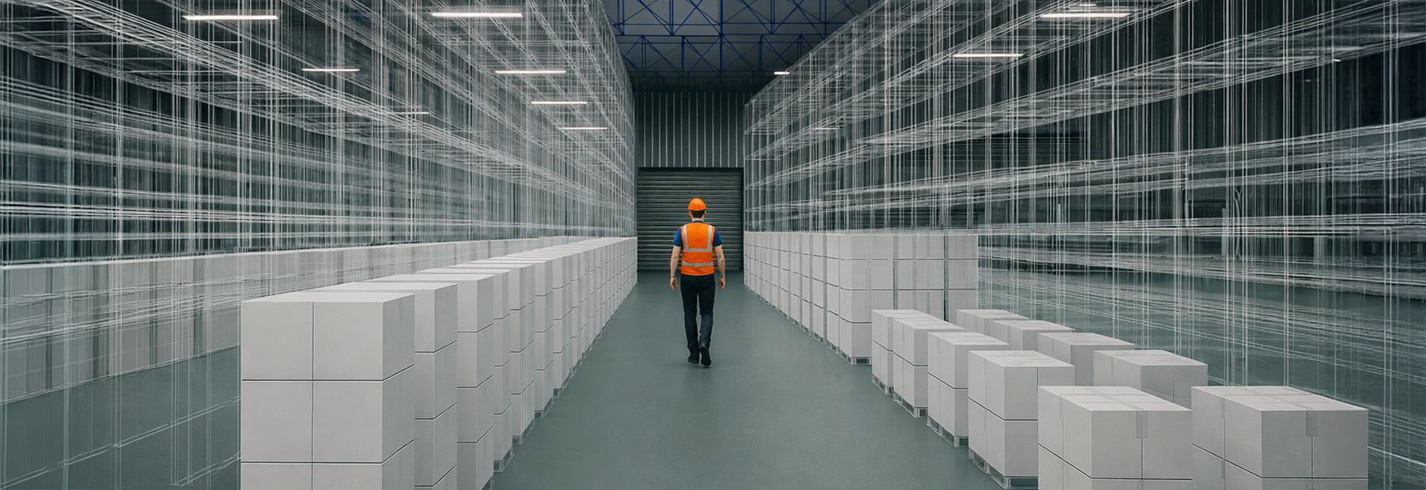
A warehouse digital twin is a live 3D visualization, data-fed model that mirrors the current state of your operations. It is built from continuous data streams coming from the warehouse management system, ERP, IoT sensors, order feeds, and physical constraints such as racking layouts and material handling equipment capacities. This integrated data set allows the digital representation to stay synchronised with the physical site.
Unlike a one-time simulation study, a digital twin is not static. It updates continuously, reflects actual performance, learns from outcomes, and closes the loop by sending improved plans back into execution systems.
The first stage of the loop is data ingestion and normalisation. Orders, inventory balances, manpower and equipment capacities, lead times, and SLAs are collected from different systems and harmonised into a consistent format. This step ensures that the twin is working with reliable, comparable information.
Next, the model is calibrated with actual layouts, and material handling characteristics. It then generates optimised operating plans, such as pick paths, dock schedules, or routing proposals, which are written back into operational tools. Once execution takes place, actual performance is captured and compared with the plan, and parameters are adjusted to improve the next cycle.
To realise full value, organisations need structured governance around the twin. This starts with comparing a pre-twin baseline against post-twin performance each month across metrics such as order cycle time, pick productivity, space utilisation, and damage rates. Exception drill-downs then guide root-cause analysis, and a continuous improvement pipeline ensures that ideas are prioritised and implemented in a consistent way.
As more sites are onboarded, the twin becomes a central tool for coordinated warehousing and distribution planning. In parallel, insights from the warehouse twin can be used to inform transport network design.
Logi-View, Mahindra Logistics’ 3D Digital Twin of warehouses, brings-these advantages into operations. If you’d like to learn more about Logi-View and how it can be applied to help your own operations, please get in touch with us at: enquiries@mahindralogistics.com.
A digital twin in supply chain management is a real-time digital replica of logistics operations such as warehouses, inventory movement, and order flows. It uses data from systems like WMS, ERP, and IoT sensors to mirror physical operations and support better planning and decision-making.
A digital twin provides real-time insights into inventory positions, warehouse activity, and operational performance. This helps logistics teams monitor operations continuously and identify potential issues before they affect delivery timelines.
Digital twins allow businesses to simulate warehouse layouts, picking routes, and storage strategies. By testing different operational scenarios digitally, companies can improve space utilization, productivity, and order fulfillment efficiency.
A digital twin typically uses data from warehouse management systems, ERP platforms, IoT sensors, inventory feeds, and material handling equipment systems. These data streams keep the digital model synchronized with real operations.
Digital twins help companies improve operational efficiency, optimize warehouse layouts, predict disruptions, and support data-driven decision-making. They also enable continuous improvement by comparing planned and actual performance.
A digital twin can simulate different supply chain scenarios such as demand changes and inventory placement. This helps businesses evaluate the impact of decisions before implementing them in real operations.
By simulating workflows and monitoring real-time performance, digital twins help identify congestion points, manpower shortages, and inventory mismatches early. This allows teams to resolve issues before they impact operations.
A digital twin provides real-time visibility into inventory location, movement, and stock levels across warehouses. This helps businesses maintain accurate inventory records and improve fulfillment reliability.